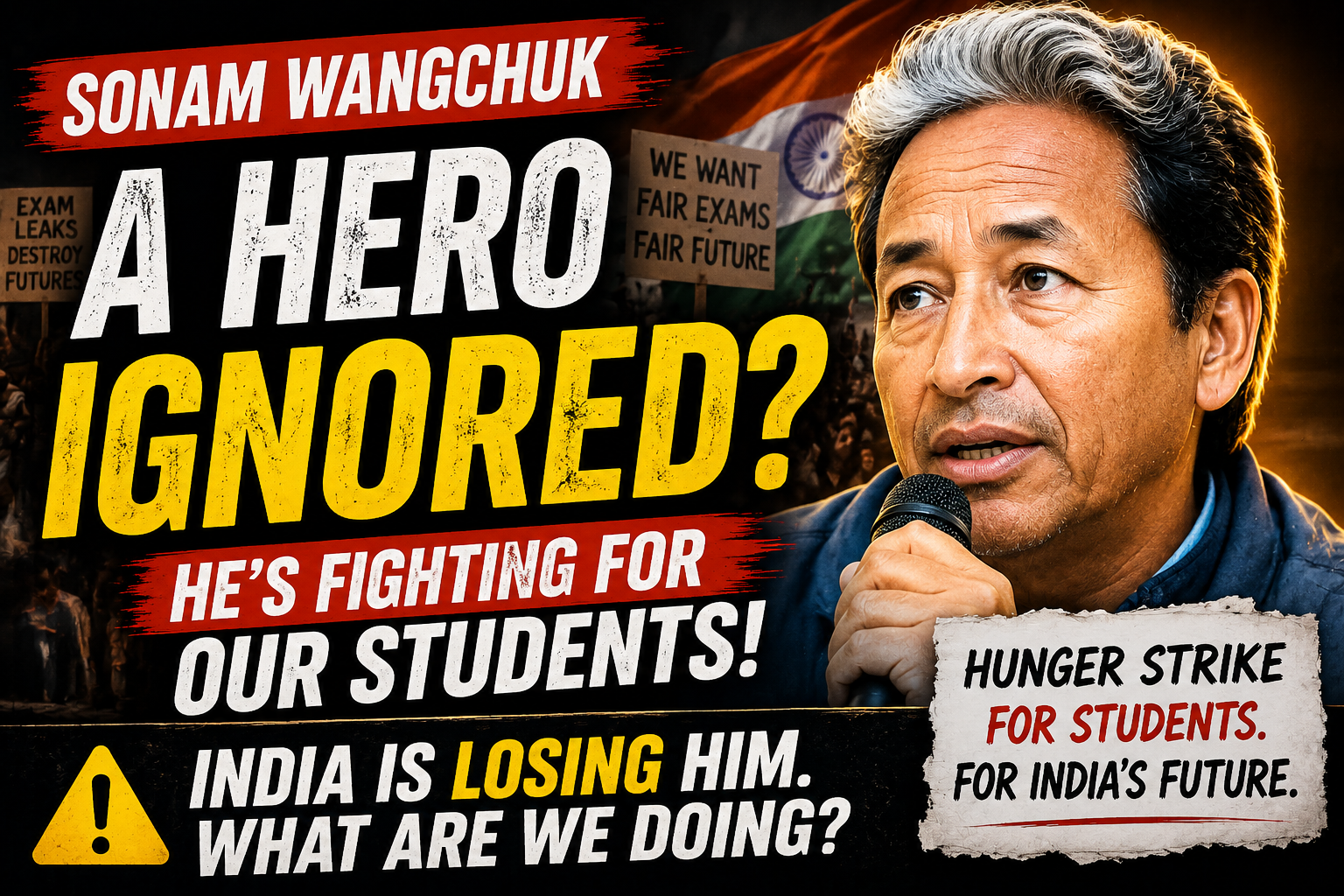
I usually write about my personal life here—my everyday experiences, my relationship, my work, my happiness, and sometimes my pain. But today, something happening in India has been disturbing me, and I genuinely feel that I need to write about it.
It’s about Sonam Wangchuk.
Today, when I read about what is happening to him, I felt worried, angry, and honestly disappointed. This is a man I have admired for the things he has done in education, innovation, sustainability, and for the people of Ladakh. And now, seeing him put his own health on the line while standing for issues affecting students makes me ask a very uncomfortable question:
Are we slowly losing people who genuinely care about the future of this country?
As of July 18, 2026, Wangchuk has been moved to a government hospital in Delhi after his health deteriorated during the 21st day of his hunger strike. He had begun fasting on June 28 while supporting protests over alleged examination irregularities and demands for accountability in India’s education system.
And that is something I simply cannot ignore.
This Is the Sonam Wangchuk India Should Remember
Sonam Wangchuk is not someone who suddenly appeared because of a protest.
For years, he has been known as an engineer, educator, innovator, environmentalist and activist. His work with the Students’ Educational and Cultural Movement of Ladakh (SECMOL) focused on creating more practical and meaningful approaches to education, while his environmental innovations—including ice stupas—brought international attention to sustainable solutions for communities facing water challenges.
Think about that for a moment.
A man spends decades trying to solve problems.
He works for students.
He works for education.
He works for the environment.
He tries to find solutions rather than simply complaining about problems.
And today, at the age of 59, that same man has pushed his body to the point where his health deteriorated after weeks of fasting.
Whatever your politics may be, shouldn’t that at least make us stop for a moment and listen?
He Is Standing With Students
What worries me most is what this protest represents.
Wangchuk joined students and young professionals protesting alleged irregularities in examinations and recruitment tests. He later began his hunger strike as part of a movement demanding accountability over alleged exam paper leaks and irregularities affecting students.
For a student, an examination is not just a few hours spent inside a classroom.
Behind that examination could be years of preparation.
Parents may have spent their savings.
Students may have sacrificed sleep, entertainment, friendships and sometimes even their physical and mental well-being.
They study because they believe in something very simple:
If I work hard, I will get a fair chance.
When that trust is damaged by allegations of paper leaks or examination irregularities, the damage goes far beyond a question paper.
It damages faith in the system itself.
And when students begin feeling that their hard work doesn’t matter, we should all be worried.
Because these students are not just fighting for an examination result.
They are fighting for their future.
And their future is India’s future.
How Long Does Someone Have to Starve Before We Listen?
This is the part that makes me angry.
Why does a person have to stop eating for days just to make people pay attention?
Why should someone’s health have to deteriorate before an issue becomes important enough for the country to discuss?
According to Reuters, Wangchuk was moved to hospital after his condition deteriorated during the 21st day of his hunger strike. Authorities said the intervention followed medical advice and a Delhi High Court order concerning monitoring his health.
Twenty-one days.
Just think about that number.
I’m sitting comfortably while writing this blog. Most of us are living our normal lives—eating our meals, scrolling through social media, watching movies and going to work.
Meanwhile, a 59-year-old man was willing to put his own health at risk while raising his voice alongside students.
How did we reach a point where this became necessary?
This Shouldn’t Be About Political Parties
I don’t want to turn this blog into BJP versus Congress, left versus right, or government versus opposition.
That’s exactly where we lose the real conversation.
For me, this is about students.
It’s about education.
It’s about accountability.
And most importantly, it’s about the future of India.
Political parties will come and go. Governments will change. Leaders will change.
But the students studying in classrooms today will become tomorrow’s doctors, engineers, scientists, teachers, entrepreneurs and leaders.
If there are genuine problems within our examination and education systems, investigate them properly.
Fix them.
Hold the responsible people accountable.
And communicate transparently with students.
Why should asking for accountability become a political issue?
We Celebrate People Only After We Lose Them
This thought genuinely scares me.
Sometimes, as a society, we don’t understand the value of people while they are still standing in front of us.
We ignore them.
We question them.
We debate their intentions.
And years later, we make documentaries about them and call them heroes.
Why?
Why can’t we listen to people while they are still here?
I’m not saying that every demand made by every protester must automatically be accepted. Democracy doesn’t work that way. Governments have responsibilities, legal processes exist, and complicated issues require discussion.
But listening costs nothing.
Dialogue costs nothing.
Acknowledging genuine concerns costs nothing.
A democracy should be strong enough to hear uncomfortable questions.
I’m Angry, But More Than That, I’m Worried
My anger doesn’t come from hatred toward India.
It comes from exactly the opposite.
I care about my country.
I want India to grow.
I want us to become stronger.
I want Indian students to believe that if they work hard, their hard work will actually matter.
And when someone like Sonam Wangchuk stands with young people asking questions about their future, I believe we should at least listen.
I don’t want another generation of students growing up believing that nothing will change.
I don’t want talented young Indians losing hope in the system.
And I certainly don’t want a person to destroy his health just to make us pay attention.
India Needs People Who Ask Questions
Patriotism, in my opinion, isn’t about pretending that everything in your country is perfect.
Sometimes, loving your country means asking why something isn’t working.
Sometimes, it means demanding better.
Sometimes, it means standing beside the people who don’t have enough power to make themselves heard.
Sonam Wangchuk himself recently urged citizens not to treat him as a hero, but to take responsibility themselves as citizens.
Maybe that’s the message we should take from all of this.
Don’t wait for another Sonam Wangchuk.
Don’t wait for another person to stop eating.
Don’t wait until someone’s health collapses.
Ask questions.
Read.
Understand.
And care.
My Only Hope
I hope Sonam Wangchuk recovers.
I hope the concerns of India’s students receive serious attention.
I hope meaningful conversations happen instead of everything eventually disappearing from the news cycle.
And I hope we never reach a day when we look back and say:
“We had people who genuinely cared about the country, but we didn’t listen to them when we had the chance.”
Sonam Wangchuk has already given India decades of his ideas, innovation, education and activism.
Today, perhaps India needs to give him something in return.
An ear that listens.
And to every student fighting honestly for a fair future—I hope your voices are heard.
Because you are not just fighting for your examinations.
You are fighting for the India you will inherit tomorrow.